UNESCO World Heritage Sites in India Explained
How a place becomes a World Heritage Site, the cultural, natural and mixed sites in India grouped by region, and the facts about them that quizzes ask most often.
By DesiQuiz Editorial Team· Updated 9 Oct 2026· 4 min readMonuments quiz
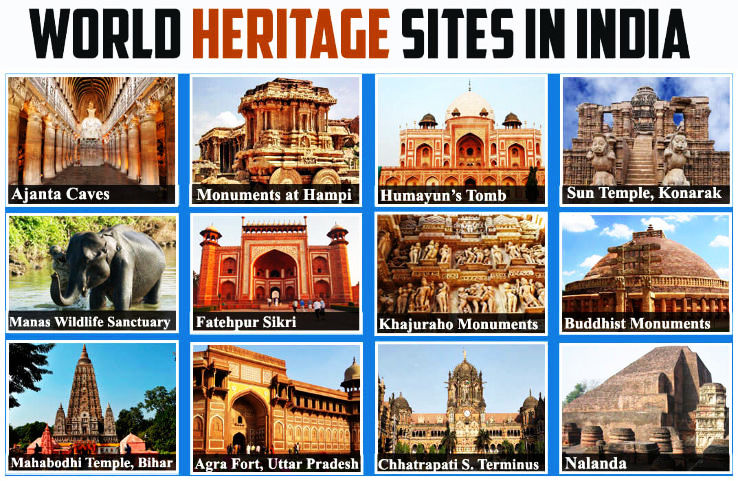
India has more than 40 sites on the UNESCO World Heritage List, and the number keeps growing as new sites are inscribed each year. They fall into three types: cultural (the large majority), natural and mixed. Quiz questions usually ask which state a site is in, who built it, or which site was the first of its kind.
How a site gets on the list
A country first places a site on its Tentative List, then submits a nomination file. Advisory bodies (ICOMOS for cultural sites, IUCN for natural sites) evaluate it, and the World Heritage Committee decides at its annual session. A site must show Outstanding Universal Value against at least one of ten criteria.
India ratified the World Heritage Convention in 1977. The first Indian sites were inscribed in 1983: the Ajanta Caves, Ellora Caves, Agra Fort and the Taj Mahal.
Cultural sites by region
North
- Taj Mahal and Agra Fort (Uttar Pradesh), Fatehpur Sikri (Uttar Pradesh, Akbar's capital)
- Red Fort Complex, Humayun's Tomb and Qutb Minar (Delhi), and Jantar Mantar in Jaipur (an astronomical observatory by Maharaja Sawai Jai Singh II)
- Hill Forts of Rajasthan (Chittorgarh, Kumbhalgarh, Sawai Madhopur, Jhalawar, Jaipur and Jaisalmer) and Jaipur City
- Capitol Complex, Chandigarh (Le Corbusier's architectural work)
- Mountain Railways of India: the Darjeeling Himalayan, Nilgiri and Kalka-Shimla lines
West
- Ajanta and Ellora Caves, and Elephanta Caves (Maharashtra)
- Chhatrapati Shivaji Terminus and the Victorian Gothic and Art Deco ensembles of Mumbai
- Rani ki Vav (Patan, Gujarat), Champaner-Pavagadh Archaeological Park, and the Historic City of Ahmedabad
- Dholavira, a Harappan city (Gujarat), inscribed in 2021
Central and east
- Sanchi Buddhist Monuments and the Rock Shelters of Bhimbetka (Madhya Pradesh), and the Khajuraho Group of Monuments
- Mahabodhi Temple Complex at Bodh Gaya (Bihar) and the ruins of Nalanda Mahavihara
- Sun Temple at Konark (Odisha)
- Santiniketan in West Bengal, inscribed in 2023
South
- Group of Monuments at Hampi and at Pattadakal (Karnataka), and the Sacred Ensembles of the Hoysala
- Group of Monuments at Mahabalipuram and the Great Living Chola Temples (Tamil Nadu)
- Churches and Convents of Goa
- Kakatiya Rudreshwara (Ramappa) Temple in Telangana
North-east
- Moidams, the mound-burial system of the Ahom dynasty, in Assam
Natural and mixed sites
- Kaziranga and Manas National Parks (Assam), known for the one-horned rhinoceros and for tigers
- Keoladeo National Park (Rajasthan), a bird sanctuary
- Sundarbans National Park (West Bengal), the mangrove forest and home of the Royal Bengal tiger
- Nanda Devi and Valley of Flowers National Parks (Uttarakhand)
- Great Himalayan National Park (Himachal Pradesh)
- Western Ghats, a series of sites across several states and a biodiversity hotspot
- Khangchendzonga National Park (Sikkim), India's only mixed site, for natural and cultural significance
A few facts that decide quiz questions
- The Taj Mahal (Mughal, Shah Jahan, 17th century) and the Sun Temple, Konark (Eastern Ganga dynasty, 13th century, shaped as a chariot) are the most frequently asked.
- Hampi was the capital of the Vijayanagara Empire.
- Ajanta is known for Buddhist cave paintings; Ellora includes Buddhist, Hindu and Jain caves, with the Kailasa temple cut from a single rock.
- Khajuraho temples are the work of the Chandela dynasty.
- Sanchi's Great Stupa was first commissioned by Ashoka.
- Jantar Mantar (Jaipur) houses the Samrat Yantra, one of the world's largest stone sundials.
- Chhatrapati Shivaji Terminus was designed by F. W. Stevens in the Victorian Gothic style, formerly Victoria Terminus.
- Rani ki Vav is a stepwell built by the Solanki dynasty and is shaped like an inverted temple.
Common traps
- The Taj Mahal's date of inscription is 1983, not the year it was built.
- Elephanta and Ellora are different: Elephanta is on an island near Mumbai, Ellora near Aurangabad (Chhatrapati Sambhajinagar).
- Kaziranga is in Assam, not in the Sundarbans region; the Sundarbans is in West Bengal.
- Not every famous monument is on the list. The Gateway of India, the Golden Temple and the Meenakshi Temple are not World Heritage Sites.