Indian Classical Dances: Eight Forms by State
The eight classical dance forms recognised by the Sangeet Natak Akademi, where each comes from, what makes it distinct, and how they differ from folk dances.
By DesiQuiz Editorial Team· Updated 9 Oct 2026· 5 min readArt and Culture quiz
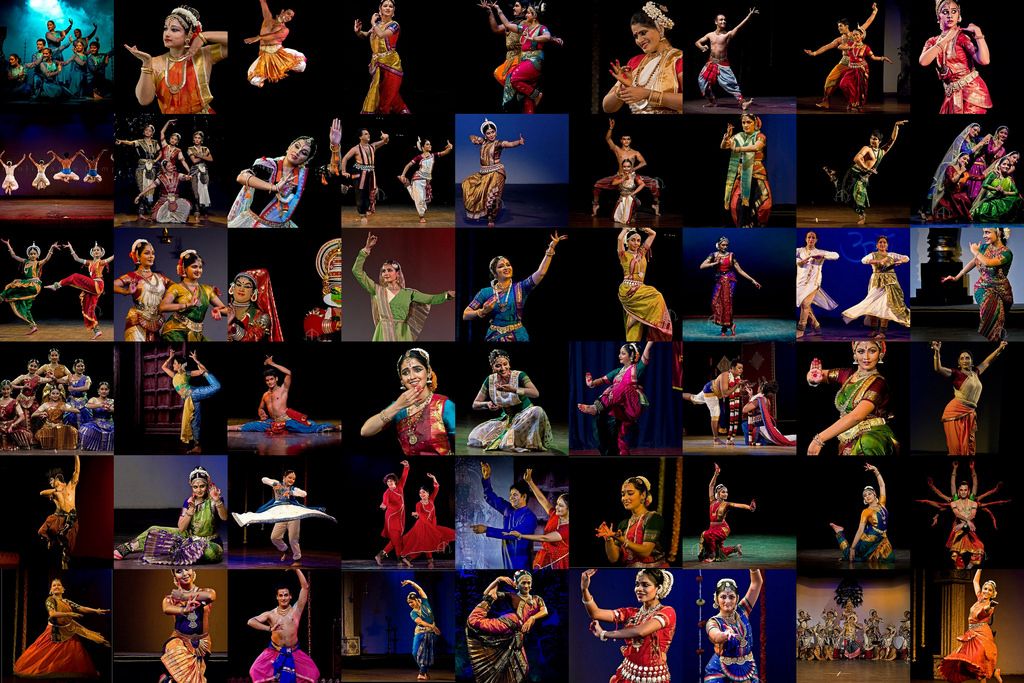
The Sangeet Natak Akademi, India's national academy for music, dance and drama, recognises eight classical dance forms. Quizzes usually ask for the state of origin, a signature feature, or a famous exponent. All eight trace back, in theory, to the Natya Shastra, the ancient treatise on performing arts attributed to Bharata Muni.
The eight classical forms
| Dance | Region | What to remember |
|---|---|---|
| Bharatanatyam | Tamil Nadu | One of the oldest and most widely taught forms; angular lines, fixed postures (araimandi), footwork and expressive hand gestures; traditionally performed in temples by devadasis |
| Kathak | North India (Uttar Pradesh, Rajasthan) | Storytelling dance; fast pirouettes (chakkars) and intricate footwork with ankle bells; shows Persian and Mughal influence |
| Kathakali | Kerala | Dance-drama with elaborate make-up and costumes; stories from the epics; strong facial expression and eye movements |
| Kuchipudi | Andhra Pradesh | Named after a village; combines dance, music and drama; includes the plate dance in which the dancer performs on the rim of a brass plate |
| Odissi | Odisha | Fluid, sculpture-like poses (tribhangi); inspired by temple carvings such as Konark and Jagannath temple traditions |
| Manipuri | Manipur | Soft, graceful movements and flowing costumes; associated with the Radha-Krishna Raslila |
| Mohiniyattam | Kerala | Female solo dance, "dance of the enchantress"; gentle swaying movements and white-and-gold costume |
| Sattriya | Assam | Developed in the sattras (Vaishnava monasteries) by Srimanta Sankardeva in the 15th-16th centuries; recognised as classical in 2000 |
Types of movement
Classical dance has three broad elements.
- Nritta: pure dance, with rhythm and movement, but no story.
- Nritya: expressive dance with abhinaya (facial expression and gesture) that conveys emotion and meaning.
- Natya: dramatic dance, bringing in dialogue or theatrical elements.
The hand gestures are called mudras; the expressive range is described by the navarasas, or nine emotions.
Kathak gharanas
Kathak developed three main schools, or gharanas: Jaipur, Lucknow and Banaras. The Lucknow gharana is known for grace and expression, and the Jaipur for rhythm and complex footwork.
Revival and famous exponents
- Rukmini Devi Arundale revived Bharatanatyam and founded Kalakshetra in Chennai.
- Birju Maharaj was a leading Kathak maestro of the Lucknow gharana.
- Kelucharan Mohapatra is credited with shaping the modern Odissi; Sonal Mansingh is another leading Odissi exponent.
- Uday Shankar pioneered creative dance blending classical and folk styles with Western stagecraft.
- Yamini Krishnamurthy and Padma Subrahmanyam are associated with Kuchipudi and Bharatanatyam respectively.
Folk dances, for contrast
Folk dances are community traditions rather than codified, textbook-based forms.
| Folk dance | State |
|---|---|
| Bhangra, Giddha | Punjab |
| Garba, Dandiya Raas | Gujarat |
| Ghoomar | Rajasthan |
| Lavani | Maharashtra |
| Bihu | Assam |
| Yakshagana | Karnataka |
| Chhau | Odisha, Jharkhand and West Bengal |
The nine emotions (navarasas)
Expression, or abhinaya, is built on nine rasas, and exam questions sometimes ask for them by name: Shringara (love), Hasya (laughter), Karuna (compassion), Raudra (anger), Veera (heroism), Bhayanaka (fear), Bibhatsa (disgust), Adbhuta (wonder) and Shanta (peace). A dancer shows a rasa through facial expression, eye movement, hand gesture (hasta) and posture.
Music, rhythm and accompaniment
- Bharatanatyam, Kuchipudi and Mohiniyattam are performed to Carnatic (south Indian) music. Kathakali has its own Kerala music tradition, with loud percussion (chenda and maddalam). Kathak follows the Hindustani tradition, and Odissi and Manipuri have distinct regional music of their own.
- Rhythm is organised in cycles called tala. Melody follows a raga.
- A typical Bharatanatyam performance has a nattuvanar (conductor) who recites the rhythmic syllables, with a mridangam (drum), violin and flute.
- Kathak's footwork is a conversation with the tabla and pakhawaj, and the dancer often improvises.
How the forms differ at a glance
| Question | Answer |
|---|---|
| Which form uses elaborate face make-up and huge headgear? | Kathakali |
| Which form shows the tribhangi posture? | Odissi |
| Which form centres on Radha-Krishna in a soft, flowing style? | Manipuri |
| Which form has spins and the three gharanas? | Kathak |
| Which form was nurtured in Vaishnava monasteries? | Sattriya |
| Which form is a graceful female solo from Kerala? | Mohiniyattam |
Institutions to know
- Sangeet Natak Akademi (New Delhi, set up in 1952) is the national academy for music, dance and drama and recognises the classical forms.
- Kalakshetra (Chennai, founded by Rukmini Devi Arundale in 1936) is a leading school of Bharatanatyam.
- Kerala Kalamandalam (founded in 1930 by the poet Vallathol Narayana Menon) trains in Kathakali and Mohiniyattam.
- Kathak Kendra in Delhi is the national institute for Kathak.
Try yourself
- Which two classical dances come from Kerala? Kathakali and Mohiniyattam.
- Which dance developed in the Vaishnava sattras of Assam? Sattriya.
- Whose name is linked to reviving Bharatanatyam in the twentieth century? Rukmini Devi Arundale.
- Is Chhau a classical dance? No, it is a folk and martial-arts-based tradition.
Common traps
- Kathakali and Mohiniyattam are both from Kerala. Kathakali is traditionally performed by men with heavy make-up; Mohiniyattam is a graceful, female solo form.
- Sattriya is the newest of the eight to be recognised, in 2000.
- Chhau and Yakshagana are not among the eight classical forms.
- Kuchipudi is from Andhra Pradesh, though it is often confused with Bharatanatyam of Tamil Nadu.