Indian Nobel Prize Winners: Who, What and When
Every Nobel Prize connected to India, the difference between Indian citizens and people of Indian origin, and the discoveries behind the prizes.
By DesiQuiz Editorial Team· Updated 9 Oct 2026· 5 min readImportant Personalities quiz
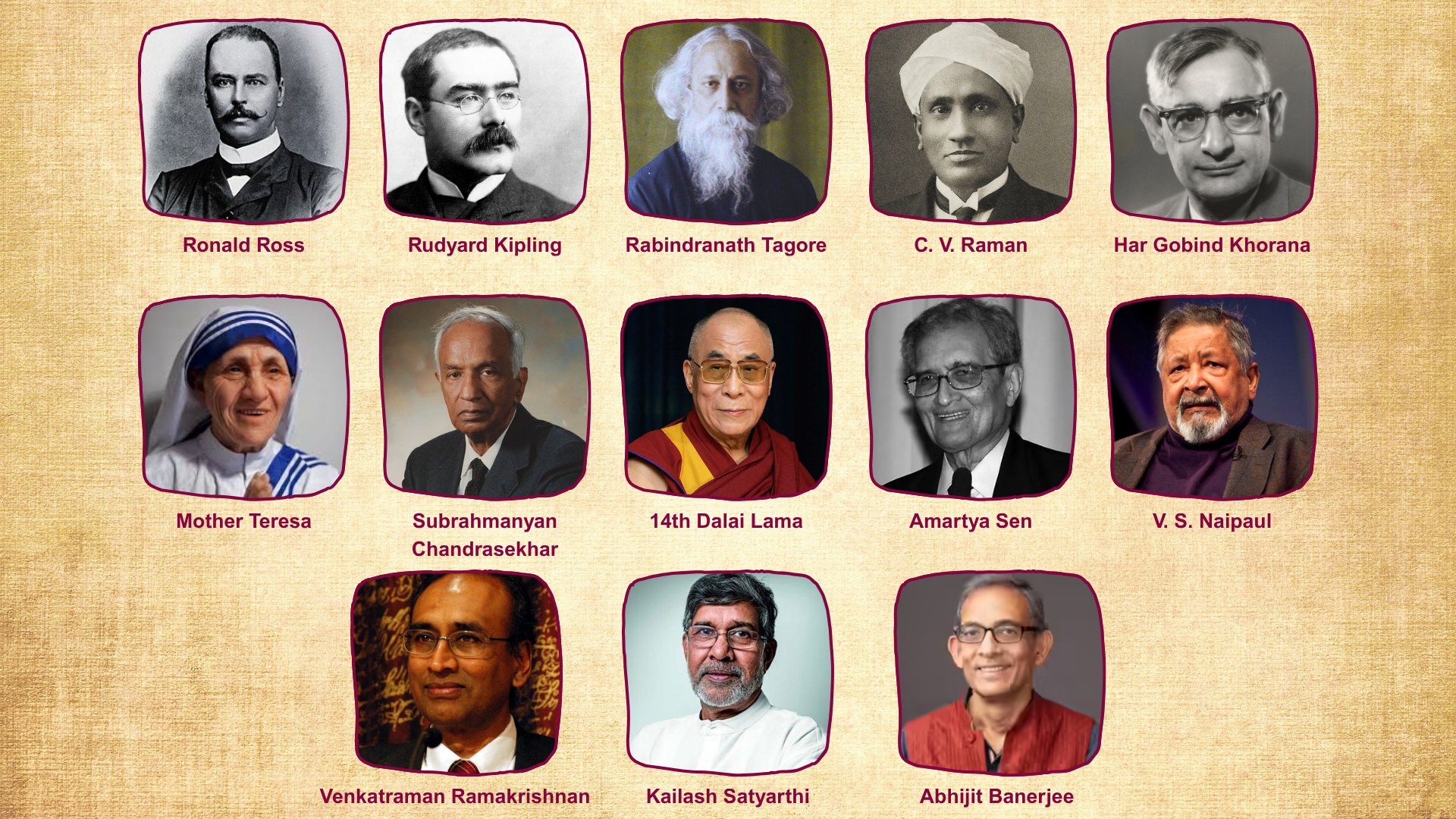
"Which Indian won the Nobel Prize for ...?" is among the most common general-knowledge questions. The confusion usually comes from who counts as an Indian laureate. A clear way to learn the list is to split it into two groups: people who were Indian citizens when they won, and people of Indian origin or birth who worked or held citizenship elsewhere.
Winners who were Indian citizens at the time
| Year | Laureate | Prize | For |
|---|---|---|---|
| 1913 | Rabindranath Tagore | Literature | Gitanjali; the first non-European Nobel laureate |
| 1930 | C. V. Raman | Physics | The scattering of light, the Raman Effect (discovered 28 February 1928) |
| 1979 | Mother Teresa | Peace | Work with the poor and dying; founder of the Missionaries of Charity in Kolkata |
| 1998 | Amartya Sen | Economic Sciences | Contributions to welfare economics and the study of famines |
| 2014 | Kailash Satyarthi | Peace | Fighting the suppression of children and for their right to education (shared with Malala Yousafzai) |
Raman is the first Asian to win a Nobel Prize in a science subject. His discovery is commemorated each year on 28 February as National Science Day.
Tagore received the prize in 1913 and renounced his knighthood in 1919 after Jallianwala Bagh. He wrote the national anthems of both India and Bangladesh.
Winners of Indian origin or birth
| Year | Laureate | Prize | For |
|---|---|---|---|
| 1968 | Har Gobind Khorana | Physiology or Medicine | Interpreting the genetic code and its function in protein synthesis (shared) |
| 1983 | Subrahmanyan Chandrasekhar | Physics | Theoretical work on the evolution of stars (shared); known for the Chandrasekhar limit |
| 2009 | Venkatraman Ramakrishnan | Chemistry | The structure and function of the ribosome (shared) |
| 2019 | Abhijit Banerjee | Economic Sciences | An experimental approach to alleviating global poverty (shared) |
Chandrasekhar was the nephew of C. V. Raman. Khorana, Chandrasekhar, Ramakrishnan and Banerjee all worked or held citizenship abroad when they won, which is why they are described as Indian-origin or Indian-born laureates, not Indian laureates.
Others linked to India
- Ronald Ross (1902, Medicine) was born in Almora, India, and made his discovery of how malaria is transmitted in Secunderabad.
- Rudyard Kipling (1907, Literature) was born in Bombay.
- The Dalai Lama (1989, Peace) has lived in India in exile since 1959.
What each of them actually did
- Rabindranath Tagore wrote Gitanjali (Song Offerings), a collection of poems he translated into English himself. He also founded Visva-Bharati at Santiniketan and wrote the anthems of India (Jana Gana Mana) and Bangladesh (Amar Shonar Bangla).
- C. V. Raman found that when light passes through a transparent material, a small part is scattered with a changed wavelength. The effect was first observed in 1928 at the Indian Association for the Cultivation of Science in Calcutta, and earned him the Physics prize in 1930. He later founded the Raman Research Institute in Bengaluru.
- Mother Teresa was born in Skopje in what is today North Macedonia, came to India in 1929 and became an Indian citizen. She founded the Missionaries of Charity in Calcutta in 1950.
- Amartya Sen was born in Santiniketan and studied at Presidency College, Calcutta, and Cambridge. His work covers famine, poverty and social choice theory. He was Master of Trinity College, Cambridge.
- Kailash Satyarthi founded the Bachpan Bachao Andolan (Save the Childhood Movement) and has led efforts to free children from bonded labour.
- Har Gobind Khorana was born in a village in what is now Pakistan. His work showed how the sequence of nucleotides in RNA specifies amino acids.
- S. Chandrasekhar showed that a white dwarf star above a certain mass (about 1.4 times the Sun's) cannot remain stable and will collapse, a result that underlies the study of neutron stars and black holes. NASA's Chandra X-ray Observatory is named for him.
- Venkatraman Ramakrishnan was born in Chidambaram, Tamil Nadu. He shared the 2009 prize with Thomas Steitz and Ada Yonath for work on the ribosome, the cell's protein factory.
- Abhijit Banerjee was born in Mumbai (then Bombay). He shared the 2019 prize with Esther Duflo and Michael Kremer for their experimental approach to fighting poverty.
Great Indians who did not win
Questions sometimes turn on a famous name that did not receive a Nobel Prize:
- Mahatma Gandhi was nominated several times for the Peace Prize between 1937 and 1948 but never received it. The Nobel Committee later publicly expressed regret.
- Jagadish Chandra Bose and Srinivasa Ramanujan were pioneering scientists and mathematicians, but neither received the prize. Mathematics has no Nobel Prize.
- Satyendra Nath Bose, whose work gave bosons their name, was never awarded one.
Trying to remember the list
- Learn the five citizens in order: Tagore, Raman, Mother Teresa, Sen, Satyarthi.
- Attach the field to each: literature, physics, peace, economics, peace.
- Learn the four Indian-origin names with their subjects: medicine, physics, chemistry, economics.
Related honours
The Bharat Ratna is India's highest civilian honour. Raman was among its first recipients in 1954, and Amartya Sen received it in 1999. Birthplaces also come up in questions: Raman was born in Tiruchirappalli (Tamil Nadu), Tagore in Calcutta, and Sen in Santiniketan (West Bengal).
Common traps
- Mother Teresa was awarded the Nobel Peace Prize in 1979, and was an Indian citizen. Her birthplace was Skopje.
- Chandrasekhar and Raman are two different physicists, an uncle and a nephew.
- Satyarthi shared the 2014 Peace Prize with Malala Yousafzai.
- Tagore's Nobel was for literature, not peace.